
identifying-and-teaching-children-and-young-people-with-dyslexia-and-literacy-difficulties-2009/
Identifying and Teaching Children and Young People with Dyslexia and Literacy Difficulties (2009)
1. Monitor Progress
- Adapt teaching in the classroom – Teachers notice individual differences and adjust their teaching. In Early Years, this can entail monitoring
of children’s responses to the content of Phase
One in Letters and Sounds (sound discrimination, rhythm and rhyme, alliteration, oral blending and segmenting). For example, in the Reception Class, monitoring responses to letter recognition, and to blending and segmenting short vowel-consonant and consonant-vowel- consonant combinations. - Universal high quality teaching – Bearing in
mind that children’s rates of progress may vary considerably, these observations provide a useful initial step in identifying children with early language or literacy difficulties. Throughout, teachers willalso observe children’s progress in relation to the language comprehension areas of literacy. Records of a child’s progress through the phases of Letters and Sounds (or similar materials) will also signal a need for closer observation. - Alert parents to concerns – It is important to ensure that a child’s hearing and vision have been checked, and that the possibility of any unidentified learning disability is considered. Concerns about literacy difficulties should be discussed with the child’s parents or carers.
School records of previous progress/concerns, interventions and the child’s response to them provide the basis for further action.
Classes/age groups can be screened through standardised reading and spelling tests to identify those who struggle with literacy. Group spelling tests are easy to administer and an analysis of the errors made by those performing with difficulty provides useful initial information.
Within primary schools, teachers will know the children in their classes. Reviews of progress, together with parents/carers and the children themselves, will point to difficulties that need further investigation/action.
The Graduated Approach
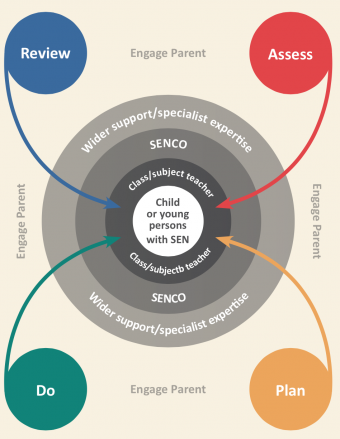
The Code of Practice for SEND 2014 recommends that classroom and subject teachers work together with the SENCO, drawing in specialist expertise to remove barriers to learning and put in place effective provision in the form of a four-part cycle of assessment, planning, action and review. This is known as the graduated approach.
In secondary schools, subject teachers noticing literacy and dyslexic difficulties should bring learners to the notice of those in their school with knowledge in this area.
As dyslexic difficulties range from mild to severe, an ‘open door’ approach is needed that gives pupils (and their parents/carers) easy access to appropriate advice. Learners with relatively mild difficulties, or those whose reading difficulties seem to be well-compensated, may struggle with aspects such as spelling, reading fluency and writing speed, and should be encouraged to discuss their concerns.
2. Skills Assessment
Inform universal high quality teaching and consider appropriateness of SEN interventions (either targeted or specialist).
The children’s parents/carers will already have been involved at the monitoring stage of assessment. They now become part of the team formed by the class teacher and available specialist teachers to undertake closer observations. The views and experiences of the children themselves are also important here.
Curriculum-based assessment establishes a clear starting point for a teaching approach that is systematic and repetitive (particularly in relation to phonics) and also takes account of language comprehension processes in literacy learning.
Skills assessment examines a child’s approaches to learning e.g. how fluent/effortful it is to recall letters and words, how many repetitions seem to be required before new learning is retained. Weaknesses in phonological processing and memory can be assessed or inferred from these observations and supplementary tests of these skills.
Standardised tests of reading and spelling enable comparisons to be made in relation to children whose progress is not causing concern.
The possibility of co-occurring difficulties needs to be considered. It is also essential to take account of the feelings of frustration and anxiety that the child may have.
For older children there is likely to be a need for:
• Investigation of the extent to which basic reading and spelling continue to be problematic.
• Administration of individual standardised tests of reading, spelling and writing speed.
• Closer examination of phonological and memory processes and the learner’s approaches to reading and spelling e.g. how fluent/effortful it is to read and write.
• Discussion of associated problems, coping strategies, curriculum access and examination arrangements where appropriate.
• Evaluation of possible co-occurring difficulties.
• Discussion with all concerned how feelings of frustration and anxiety can be alleviated.
• Where a learning difficulty is identified, and requires special educational provision to be made, parents or carers must be informed if a decision is made that the child requires special educational provision.
3. Comprehensive Assessment
Usually a highly personalised intervention but may need to be more long-term and/or entail specialist teaching.
The school decides to seek outside advice and help from specialist teachers and educational psychologists and from other professionals as necessary, such as speech and occupational therapists.
Parents’ views and the views of the child or young person, are sought and recorded and they are kept fully informed throughout the process.
Where assessment indicates that support from specialist services is required, it is important that children and young people receive it as quickly as possible. Joint commissioning arrangements should seek to ensure that there are sufficient services to meet the needs in an area. The Local Offer should set out clearly what support is available from different services and how it may be accessed.
All the information gathered so far forms part of a comprehensive appraisal of the nature and extent of the child’s difficulties.
Further assessments examine more closely the child’s individual strengths and weaknesses.
Complex problems, such as those associated with marked co-occurring difficulties or emotional and social circumstances are likely to need the advice of educational psychologists or CAMHS.
Schools should work closely with the Local Authority and other providers to agree the range of local services and clear arrangements for making appropriate requests. This might include schools commissioning specialist services directly
4. Requesting an Education, Health and Care needs assessment (New from September 2014)
SEN support should be adapted or replaced depending on how effective it has been in achieving the agreed outcomes. Where, despite the school having taken relevant and purposeful action to identify, assess and meet the SEN of the child or young person, the child
or young person has not made progress, the school or parents should consider requesting an Education, Health and Care needs assessment. To inform its decision the local authority will expect to see evidence of the action taken by the school as part of SEN support.
What article would you like to read?
1. Choosing an Intervention for pupils with Literacy Difficulties and/or Dyslexia
3. Children with Persistent Literacy Difficulties
4. Specialist Advice and Support
6. Role of the Specialist Teacher
7. Identifying and Teaching Children and Young People with Dyslexia and Literacy Difficulties (2009)
Identifying and Teaching Children and Young People with Dyslexia and Literacy Difficulties
Download Article